Why ISO certifications matter more than ever when choosing a digital infrastructure partner
17 July 2026
786
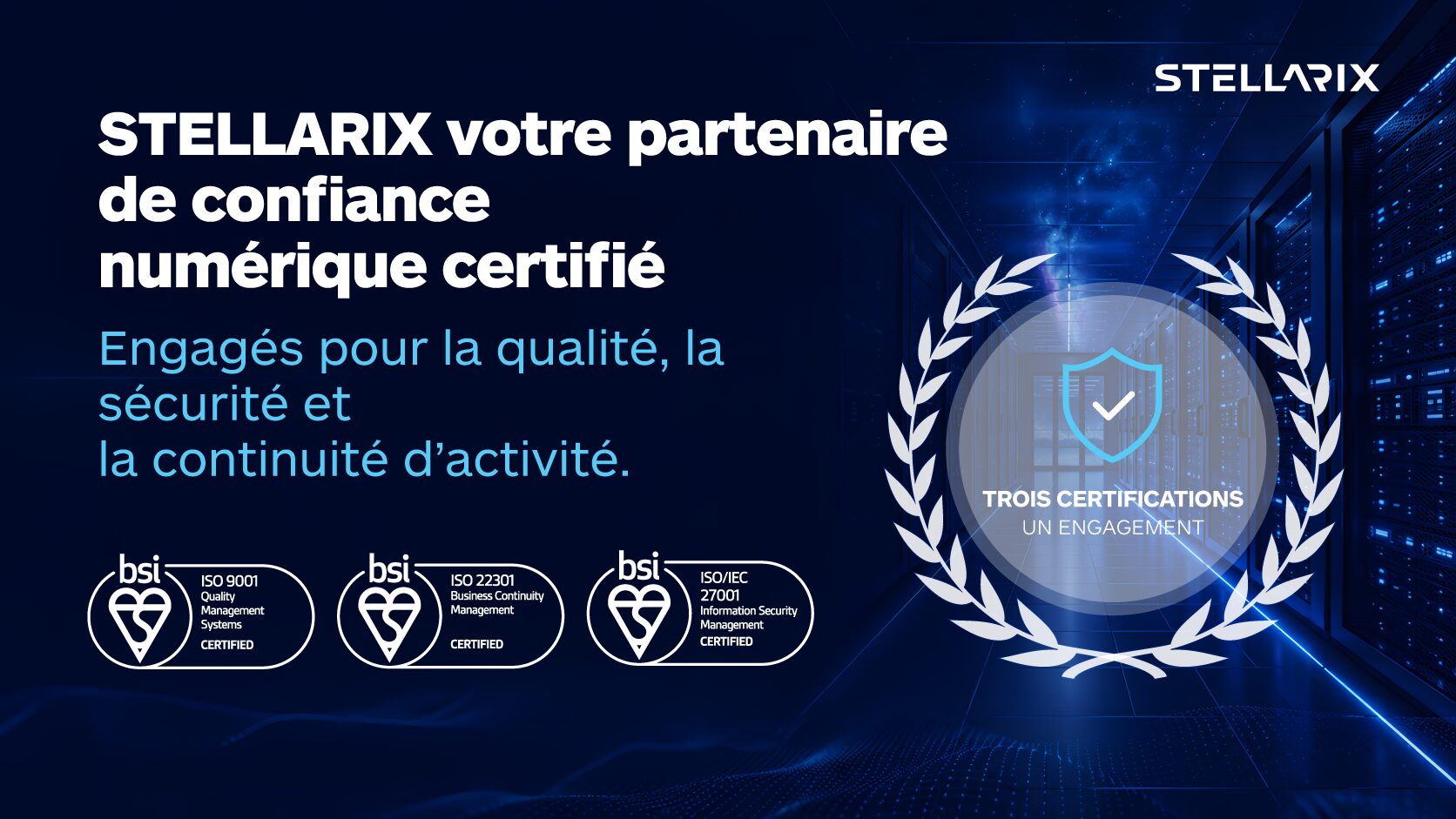
STELLARIX’s triple ISO 9001, ISO 22301 and ISO/IEC 27001 certification demonstrates its commitment to delivering secure, resilient and high-quality digital infrastructure that helps organizations across Africa operate with confidence.
Downtime, data breaches and operational failures no longer represent isolated IT issues. They directly impact revenue, reputation and long-term growth.
When choosing a digital infrastructure partner, the real question is not performance alone. It is whether your business can operate without disruption, protect critical data and scale with confidence. Across Africa, where digital transformation is accelerating rapidly, these risks are becoming even more critical for both private and public organizations.
A payment is processed in milliseconds. A hospital retrieves a patient’s medical record instantly. A manufacturer synchronizes production data across multiple countries. A government portal remains available during a period of high demand. These everyday interactions depend on something most users never see: resilient digital infrastructure.
Today, digital infrastructure is no longer just an IT concern. It is the foundation of business continuity, customer experience and organizational growth.
As more organizations move critical workloads to the cloud, rely on colocation facilities and manage sensitive data online, the expectations placed on infrastructure providers continue to rise.
Performance still matters. But performance alone is no longer enough. Business leaders also want confidence that their technology partner can deliver consistent service quality, protect critical information and maintain operations when unexpected events occur.
In other words, they are looking for partners they can trust. That trust cannot rely solely on marketing claims or technical specifications. It must be demonstrated through internationally recognized management systems that are independently audited against rigorous standards.
This is exactly what international certifications aim to demonstrate. And more importantly, what they mean for your business when selecting an infrastructure partner. In a market where multiple providers promise performance, these certifications help differentiate those who can actually deliver it consistently. This is precisely where ISO certifications make a difference.
Why ISO certifications have become a strategic business requirement
The digital risk landscape has changed dramatically over the past few years.
Cyberattacks have become more frequent and more sophisticated. Organizations are increasingly exposed to supply chain disruptions, operational incidents and stricter regulatory requirements. At the same time, customers expect uninterrupted digital services regardless of external circumstances.
The financial impact of these risks continues to grow. According to IBM’s Cost of a Data Breach Report 2025, the global average cost of a data breach reached USD 4.44 million, illustrating how governance, resilience and information security have become business priorities, not just technical ones.
Business continuity has become equally critical. Whether caused by cyber incidents, power outages, human error or natural disasters, operational disruptions can quickly affect revenue, reputation and customer confidence.
For organizations operating across multiple African markets, these challenges are even more significant. Digital transformation is accelerating across sectors such as financial services, healthcare, telecommunications and public administration, making resilient infrastructure a strategic asset for economic growth.
As a result, organizations are no longer choosing infrastructure providers based only on capacity, latency or uptime.
They are also asking questions such as:
- How are operational processes managed?
- How is sensitive information protected?
- How prepared is the provider for unexpected disruptions?
- Does the organization follow internationally recognized best practices?
International standards such as ISO 9001, ISO 22301 and ISO/IEC 27001 provide objective answers to these questions.
Rather than certifying technologies, they certify the management systems that govern how an organization delivers quality, manages risk and continuously improves its operations.
For customers, this provides an additional level of confidence that critical services are supported by disciplined processes, not improvised responses.
How STELLARIX demonstrates this commitment
Against this backdrop, STELLARIX has strengthened its commitment to trusted digital infrastructure by achieving three internationally recognized certifications awarded by the British Standards Institution (BSI):
- ISO 9001 for Quality Management Systems
- ISO 22301 for Business Continuity Management Systems
- ISO/IEC 27001 for Information Security Management Systems
These certifications cover STELLARIX’s operations in Madagascar, Senegal and Tanzania, supporting the company’s mission to deliver reliable, secure and resilient digital infrastructure across Africa.
More importantly, these certifications are not permanent distinctions.
Each certification is valid for three years and is subject to annual surveillance audits conducted by independent auditors. This means STELLARIX must continuously demonstrate that its management systems remain effective, compliant and continually improving, not only at the time of certification, but throughout the certification cycle.
This distinction is essential. ISO certifications are often perceived as compliance badges. In reality, they represent an ongoing commitment to operational excellence, resilience and governance that is independently verified over time.
For organizations choosing a long-term infrastructure partner, this level of assurance can make a meaningful difference.
The next question is therefore the one that matters most:
What do these three certifications actually mean for your business, and how do they create value beyond compliance?
What these three ISO certifications actually mean for your business
For many organizations, ISO certifications can seem abstract, valuable in principle, but difficult to connect to day-to-day business operations. That is where many companies stop. In practice, this means fewer disruptions, lower operational risk and greater financial predictability. For executives, IT leaders and financial decision-makers alike, these certifications help translate complex infrastructure choices into measurable business outcomes.
The real question is not “Which certifications does an infrastructure provider hold?” It is: “How do these certifications reduce risk, improve reliability and help my business operate with greater confidence?”
The answer lies in the complementary role of the three standards.
Rather than focusing on a single aspect of operations, ISO 9001, ISO 22301 and ISO/IEC 27001 work together to create a comprehensive management framework covering service quality, operational resilience and information security.
The real question is not “Which certifications does an infrastructure provider hold?” It is: “How do these certifications reduce risk, improve reliability and help my business operate with greater confidence?”
The answer lies in the complementary role of the three standards.
Rather than focusing on a single aspect of operations, ISO 9001, ISO 22301 and ISO/IEC 27001 work together to create a comprehensive management framework covering service quality, operational resilience and information security.
For customers, this translates into three essential business outcomes:
- more consistent service delivery;
- greater resilience when disruptions occur;
- stronger protection of critical information.
Let’s look at what each certification contributes.
ISO 9001: Delivering consistent quality every day
When businesses evaluate a digital infrastructure provider, they naturally focus on technical indicators such as uptime, latency or network performance.
These metrics are important. But they only tell part of the story. Reliable digital services are built on something much less visible: the quality of the operational processes behind them.
- How are infrastructure changes validated before deployment?
- How are incidents managed?
- How are recurring issues identified and prevented from happening again?
- How does the organization ensure that service quality remains consistent across different teams and countries?
This is precisely what ISO 9001, the world’s leading standard for Quality Management Systems (QMS), is designed to address. Rather than certifying products or technologies, ISO 9001 verifies that an organization operates through structured, documented and continuously improving processes.
For STELLARIX, this means embedding quality into every stage of service delivery through standardized procedures, measurable performance indicators, regular internal reviews and continuous improvement.
For customers, the benefits are tangible. Instead of relying on individual expertise or informal ways of working, services are delivered through repeatable processes designed to produce consistent outcomes over time.
What this means for your business
ISO 9001 provides evidence that incident analysis, corrective actions and continuous improvement are governed through documented and audited processes. Actual response and resolution commitments remain defined by the applicable SLA.
Ultimately, ISO 9001 helps reduce operational uncertainty. And when your business depends on critical digital infrastructure, predictability is every bit as valuable as performance.
ISO 22301: Building resilience before disruption happens
No organization can eliminate every operational risk. Power outages, cyberattacks, human error, supply chain disruptions and natural disasters remain realities for every business.
The difference lies in preparedness. When disruption occurs, organizations need partners that can respond in a structured, coordinated and efficient way.
This is the purpose of ISO 22301, the international standard for Business Continuity Management Systems (BCMS). Rather than focusing on incident response alone, ISO 22301 requires organizations to anticipate potential disruptions, assess their impact, define recovery priorities and regularly test continuity plans.
For STELLARIX, business continuity becomes an ongoing management discipline rather than an emergency procedure activated only when problems arise. Recovery strategies, crisis management responsibilities and business continuity processes are documented, reviewed and continuously improved.
For customers, this strengthens confidence that essential services can continue even when unexpected events occur.
What this means for your business
ISO 22301 does not guarantee that disruption will never occur. It provides independently audited evidence that continuity risks, roles, recovery priorities and testing are managed through a formal framework.
For organizations operating in sectors such as financial services, healthcare, telecommunications or the public sector, this structured approach supports stronger operational resilience and helps minimize the business impact of disruptive events.
Because resilience is no longer measured by whether incidents happen. It is measured by how effectively organizations recover from them.
ISO/IEC 27001: Protecting information through governance, not just technology
Cybersecurity is often associated with technical solutions.
- Firewalls.
- Encryption.
- Endpoint protection.
- Identity management.
These technologies are essential but they are only part of an effective security strategy. Many security incidents originate not from technological failures, but from weak governance, inconsistent processes, unclear responsibilities or unmanaged risks.
That is why information security must extend beyond technology.
ISO/IEC 27001, the international standard for Information Security Management Systems (ISMS), provides a structured framework for identifying security risks, implementing appropriate controls and continuously improving an organization’s security posture.
Its objective is to protect the confidentiality, integrity and availability of information, the three fundamental principles that underpin effective information security.
For STELLARIX, this means integrating security into operational governance rather than treating it as the responsibility of technical teams alone. Risk assessments, documented procedures, clearly defined responsibilities and regular management reviews ensure that information security evolves alongside emerging threats and changing business requirements.
What this means for your business
Partnering with an ISO/IEC 27001-certified infrastructure provider provides greater confidence that:
- sensitive information is managed within a recognized international framework;
- security risks are identified, assessed and regularly reviewed;
- governance supports continuous improvement rather than reactive responses;
- documented processes strengthen consistency across security operations;
- information security remains aligned with evolving technologies and business needs.
While no certification can eliminate cyber risk entirely, ISO/IEC 27001 demonstrates that security is managed through a disciplined, risk-based methodology designed to reduce vulnerabilities over the long term.
For organizations entrusting critical workloads, applications and sensitive data to a digital infrastructure partner, that governance provides an additional layer of confidence that technology alone cannot deliver.
Across all three certifications, a common principle emerges.
They are not simply about complying with international standards. They are about creating a management culture in which quality, resilience and security reinforce one another to support reliable digital services over the long term.
That is where the real value of STELLARIX’s triple ISO certification lies and why the combination of these three standards delivers significantly more than each certification could achieve on its own.
Why three ISO certifications deliver greater business value than one
Organizations rarely face a single type of risk. A cyberattack can interrupt business operations. An operational failure can affect service quality. A disruption can expose security weaknesses.
In today’s digital economy, these risks are interconnected. Managing them independently is no longer enough.
This is why STELLARIX’s triple ISO certification creates value beyond individual standards.
Rather than addressing quality, business continuity and information security in isolation, the three management systems reinforce one another to create a more resilient operating model.
Together, these certifications support a single objective:
Helping organizations operate with greater confidence by reducing operational risk, strengthening resilience and protecting critical business information.
For customers, this means choosing a partner whose commitment extends beyond technology itself. It reflects an organization that continuously improves the way it delivers, protects and supports digital services.
How this benefits organizations across Africa
Africa is experiencing one of the world’s fastest digital transformations.
Cloud adoption continues to accelerate. Financial institutions are expanding digital services. Governments are modernizing public platforms, while businesses increasingly rely on cloud applications, interconnected systems and data-driven operations.
As digital ecosystems grow, so does the cost of disruption.
Organizations therefore need infrastructure partners that can provide more than high-performance technology. They need partners capable of delivering operational consistency, resilience and trusted governance over the long term.
This is precisely where STELLARIX’s triple certification creates value.
The certifications awarded by the British Standards Institution (BSI) cover STELLARIX’s operations in Madagascar, Senegal and Tanzania, reinforcing internationally recognized management practices across its digital infrastructure services.
Whether organizations rely on colocation, cloud infrastructure, cybersecurity solutions or managed services, these certifications demonstrate that the management systems supporting those services are independently audited and continually improved.
For businesses expanding across Africa, this provides additional confidence that their digital foundation is supported by disciplined governance designed to evolve alongside changing technologies, customer expectations and emerging risks.
Supporting every stage of your digital transformation
As organizations modernize their IT environments, choosing the right infrastructure partner becomes a strategic decision.
STELLARIX’s certified management systems support the delivery of solutions including:
- Colocation, providing secure and resilient environments for critical IT infrastructure.
- Cloud Services, enabling scalable and reliable digital transformation.
- Cybersecurity Solutions, helping organizations strengthen information security and manage cyber risk.
- Managed Services, supporting day-to-day operations through standardized processes and continuous improvement.
Together, these services are backed not only by modern technology, but also by internationally recognized management systems designed to improve quality, resilience and information security over time.
Key takeaways
- ISO certifications are about governance, not just compliance. They demonstrate that an organization manages quality, resilience and information security through structured, independently audited management systems.
- Each certification addresses a different business challenge. ISO 9001 strengthens service quality, ISO 22301 improves business continuity, and ISO/IEC 27001 enhances information security governance.
- Their combined value is greater than the sum of their parts. Together, they help reduce operational risk, improve resilience and build long-term trust.
- For customers, the benefits are practical. More predictable service delivery, stronger resilience during disruptions and greater confidence in how critical information is protected.
- STELLARIX’s triple ISO certification reflects an ongoing commitment. Annual surveillance audits ensure that these management systems continue to evolve through continuous improvement rather than remaining static.
Conclusion
Technology alone does not create trust. Organizations depend on partners capable of delivering reliable services, protecting critical information and maintaining operations when unexpected events occur.
International standards such as ISO 9001, ISO 22301 and ISO/IEC 27001 provide an objective framework for achieving these goals through disciplined governance and continuous improvement.
By achieving certification across all three standards, STELLARIX demonstrates its commitment to managing digital infrastructure according to internationally recognized best practices, helping organizations across Africa build stronger, more resilient and more secure digital foundations for long-term growth.
Whether you are modernizing your IT infrastructure, migrating critical workloads to the cloud, strengthening cybersecurity or expanding your operations across Africa, choosing the right digital infrastructure partner is a strategic decision.
Speak with our experts to explore how STELLARIX’s certified approach can support your infrastructure strategy and reduce your operational risks.
Sources